
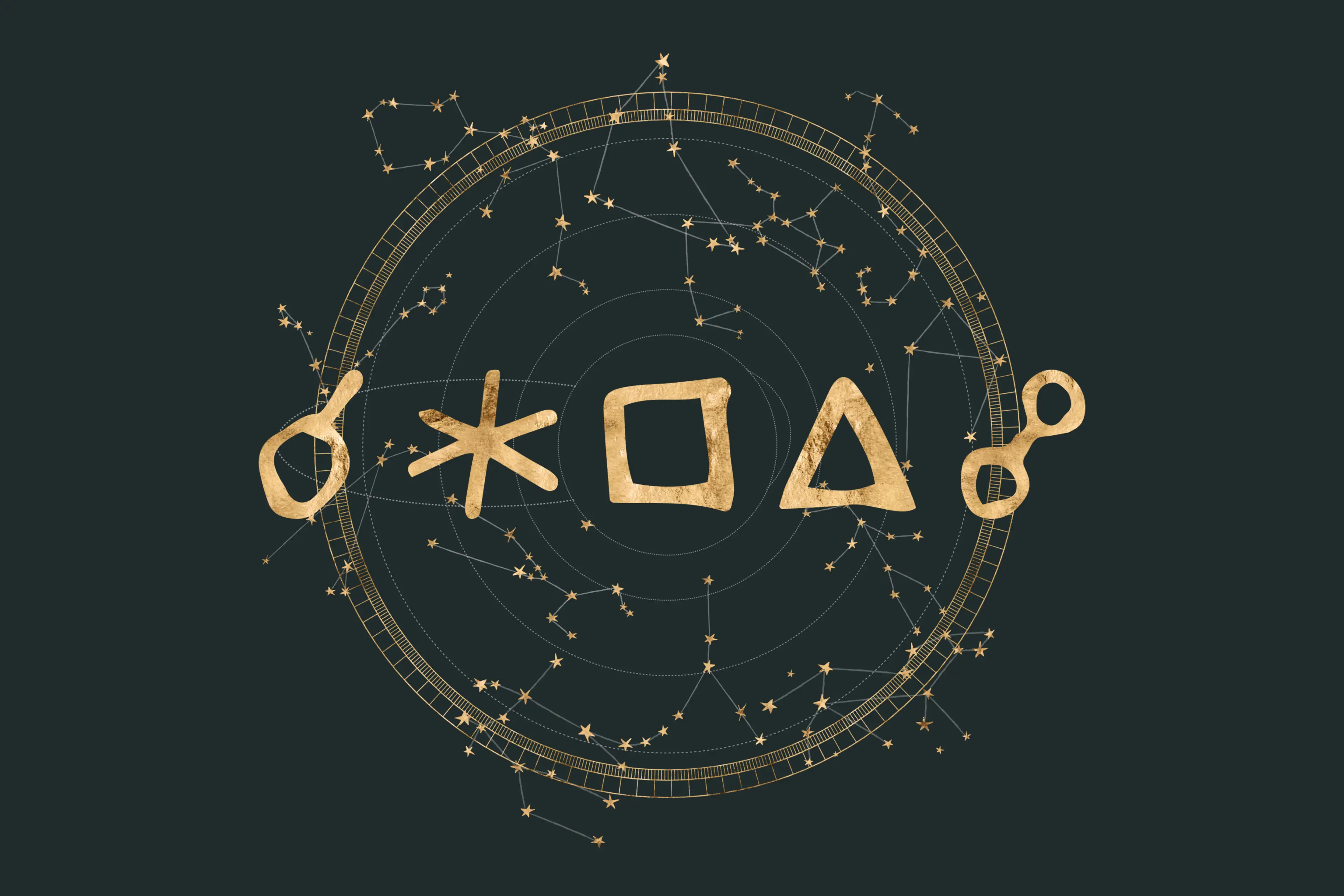
If your birth chart is the circular stage for your life’s play, planets are the actors. When astrologers refer to your aspects, they’re observing how these actors’ relative positions create internal ease or tension.
What Are Aspects?
An aspect is the angle between two celestial points—usually planets—on the 360-degree zodiac signs wheel. Unlike transits, which involve planetary movement, aspects are stable. An aspect’s influence (degrees of separation) is called an orb. The five major aspects, from closest to most distant, are as follows:
Conjunction (approximately 0°; planets usually in the same sign)
Sextile (60°; two signs apart)
Square (90°; three signs apart)
Trine (120°; four signs apart)
Opposition (180°; opposite signs on the zodiac wheel)
Each planetary aspect in astrology illustrates an aspect of your personality. What comes easily to you? Look to your trines! Which life lessons might repeat until you resolve them? For that, your squares offer insight.
Conjunctions
When two planets are in conjunction, they amplify each other, creating a focus. However, the potent energy of this aspect makes the famous advice from Spider-Man especially salient: “With great power comes great responsibility.”
For example, structured Saturn conjunct rebellious Uranus makes a person especially adaptable and ready to rebuild after change. But until that resilient person develops self-awareness, they may also favor upheaval when better options exist.
A sun and moon aspect can also indicate a struggle between your wants and needs. Yet just as a close friendship can empower you or enable bad habits, a conjunction is neither “good” nor “bad.” Your conjunct energies simply generate intensity that you learn to use wisely.
Sextiles
The sextile angle allows planets enough proximity to understand one another but enough distance to share different perspectives. In other words, this soft aspect helps your energies blend and cooperate.
In your horoscope, sextile aspects represent talents that you’re motivated to develop. Over the course of your life, you appreciate the opportunities for personal growth that these energies create.
Consider a sextile between mind-focused Mercury and action-oriented Mars. In this case, the aspect offers a sharp mind, focused curiosity, and accurate instincts. Moreover, this person is likely to recognize these qualities and hone them. By contrast, semi-sextile aspects can indicate two planets that have difficulty working together, such as cautious Jupiter and disruptive Pluto.
Squares
The square aspects have a reputation for causing internal strife. Although it’s true that planets at a square angle challenge each other, this hard aspect also offers the greatest potential for decisive action.
When you make decisions with an awareness of your squares, you resolve conflict with satisfaction and pride. But until you face your square energies, these aspects can arise as stress, resistance, or self-sabotaging impulses.
If your identity-defining Sun sign squares dreamy Neptune, for example, you might experience tension between reality and idealistic expectations. However, you overcome escapism and self-criticism when you actively choose to manifest your creative vision.
Trines
Planets at a trine angle are mutually supportive, so these aspects reflect where you shine without much effort. While trines indicate your talents, they can sometimes feel so easy that they become areas of complacency.
To illustrate, a trine between your Moon sign and Venus placement suggests an intuition that attracts caring relationships and compatibility, money, and other comforts. But you might also take this gift for granted, leading you to overindulge.
As a result, trines aren’t typically aspects that push us to self-actualize. Nonetheless, you can rely on the trines in your astrology chart to readily provide joyful vibes and relieve stress.
Oppositions
While squares teach you to address factors in tension, oppositions draw attention to your traits that lack balance. As your perspective expands, you learn how to let your oppositions guide you toward what you need.
Let’s say that your Mercury opposes your Moon placement. This aspect represents a classic battle between the head (Mercury) and the heart (Moon), leading to difficulty understanding your emotions and experiencing clarity.
Because birth chart oppositions point to imbalances, they reveal the external relationships that most benefit you. With the hypothetical opposition above, you ideally cultivate connections with nature, therapy, and kind people who give honest feedback.
Aspects in Your Birth Chart
Your astrological aspects, including the signs and houses associated with them, create a blueprint of your potential. As you explore your identity, it’s important to avoid attaching a value judgment to any particular aspect.
For instance, you might notice a relative dominance or lack of certain aspects. But a dominance of squares doesn’t make your life harder than a life of trines. In fact, a square-dominant person might confidently handle conflict.
In addition to the five major aspects, there are minor aspects such as the inconjunct (quincunx), semi-sextile, quintile, semi-square, and sesquiquadrate. Whether your natal chart aspects correspond to instincts, challenges, talents, or shortcomings, each aspect invites you to practice self-compassion.